
Never-ending work.
We struggle to be efficient towards what we want to accomplish, leading to the trap of never-ending work. That’s called Parkinson’s Law, an adage in which work expands to fill the time allocated.

NEW - Listen to this article on Spotify.
If you have led or currently lead projects as part of your job, you will often find yourself asking the same question to your cross-functional partners “How long will it take to complete this task?”. Sometimes you get the exact estimation you are looking for, other times you’ll be greeted with a grumpy colleague that will get back with a frustrating answer “I will let you know when I complete it.” However grumpy they may come across, their answer couldn’t be more accurate. The correct measurement of time is indeed only perfectly accurate once it’s completed.
What we often want to know, however, is how efficient is time being spent and how can we shorten it? But why are we so focused on cutting and reducing time? There’s a very simple reason for it - most team projects take longer than expected to be completed. Whether it’s a new feature release, the launch of a new marketing campaign, or a simple school group assignment we’ve all been in the situation where we somehow end up taking much longer than we should have. One reason for it is that we are simply not good at allocating our own time to complete tasks. Most of us have experienced taking on a small task that ended up becoming never-ending work. Why is that? We struggle to be efficient towards what we want to accomplish, leading to the trap of never-ending work. That’s called Parkinson’s Law, an old eponymous adage in which work expands to fill the time allocated for its completion.
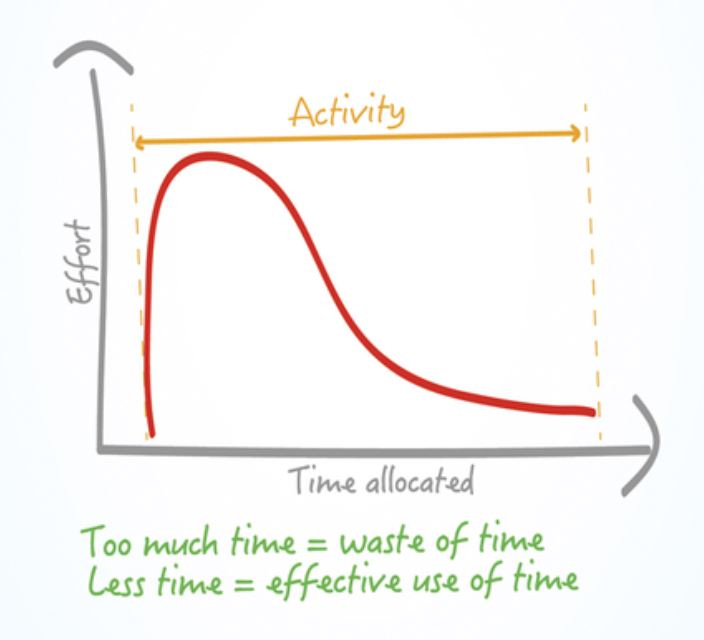
For example, imagine that you are planning to learn HTML to launch your personal website 3 months from now. According to Parkinson’s Law, the scope of your work will end up adapting to a 3-month training period, whether that is the most productive plan or not. The reality is that 1.5 months might actually be the ideal period in which you will complete the task in the most efficient way, but the additional time will see you gain comfort and may lead to procrastination or distract you from your plan. With so much time on your hands, you might start reading about other more complex languages like Python or Javascript and playing around with it extending your HTML training mission unnecessarily. One curious example where we believe to be the most efficient is during school exams period, we have always known when exam dates were due but we didn’t study every single day before that. No, we left it to the very last minute sometimes even the night before. That was not optimal planning.
To understand Parkinson’s Law, we can also look at examples in our everyday lives. If we know we have a wedding coming up in 4 months we tell ourselves we will start getting in shape and eating better so we can fit in our suits or dresses, but the reality is that we end up leaving it to the last two weeks when we throw ourselves into a superhero regime of two practices a day followed by juicing at every meal. Work gets complex which causes delays, but often it is our own procrastination that delays the goals that we intend to achieve by gaining a false sense of comfort in knowing we have plenty of time to complete a task.

How to overcome the effects of never-ending work?
Here are four areas that you can start working on every day:
Time blocking - Estimate effort and block time in your calendar to complete the task at hand giving it the exact amount of time it requires. When you block your time you are doing what’s called “intention building”, committing to do the work during the realistic time that it will most likely take to deliver it.
Allocate less time for your tasks - We’ve all fell into the trap of allocating a whole day to get that one thing done, only to realise we could have completed it in one morning.
Prioritise the important tasks - Do you really need to start your day with a 30 min session of skimming through emails? Most of the time, this exercise can be done efficiently in 5 to 10 minutes, allowing you to spend the bulk of your time working on the most important tasks.
Quality over quantity - Most times your work will be measured based on its outcome and not necessarily its output. You want to give yourself an environment where you don’t have to compromise the quality of your work. By doing so, you will avoid dragging your work for the sake of it and freeing time to stay at the top of your game.
Apply it next week
During next week, experiment the following:
Try cutting your standard task allocated time in half. Cut your 1h meetings into 30 min sessions, make your big tasks into blocks of 90-min of focused time instead of blocking out most of your day for it.
Try applying some of these principles to create efficiencies in your personal life.
At the end of next week, look back at what you have achieved. Did you accomplish less than you needed to or did you get more things done?